The Good Enough Job summary: what you should know first
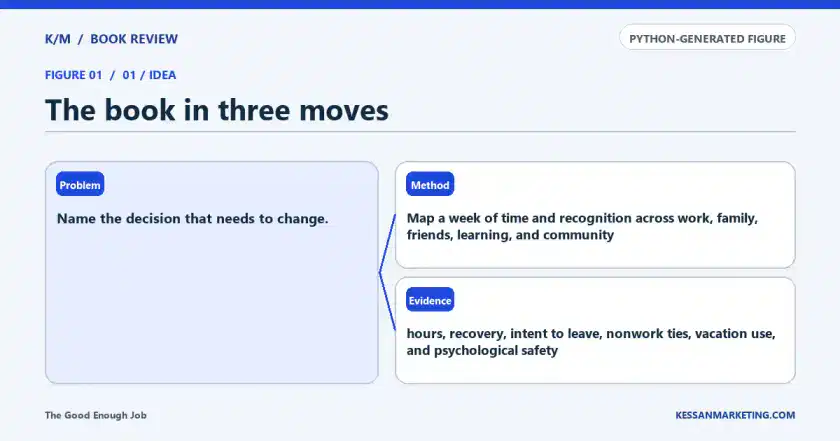
The Good Enough Job is best read as a decision system. The practical thesis is that Concentrating meaning, belonging, and self-worth in work makes both people and organizations fragile. This review turns that idea into an experiment, metrics, and explicit limits.
Find the English edition on Amazon →
Understand the book in sequence
The central idea of The Good Enough Job
The Good Enough Job is most useful when read as a decision system rather than a collection of memorable phrases. Its central practical claim is that Concentrating meaning, belonging, and self-worth in work makes both people and organizations fragile.
That claim matters because organizations often confuse visible activity with progress. More meetings, features, campaigns, or dashboards can coexist with weaker customer value and poorer economics.
A disciplined reader should therefore ask which customer or managerial decision the book changes, what evidence supports the change, and what would show that the advice does not fit the current situation.
Who should read it
This book is relevant to people who need to turn an ambiguous business problem into a sequence of choices. It is especially useful when a team has many plausible actions but no shared rule for prioritizing them.
The reader should bring one live problem to the book. Abstract agreement is easy; applying the argument to a customer, product, team, or investment exposes where assumptions and trade-offs remain hidden.
It is less useful as a source of ready-made answers. The value comes from using the author’s lens to ask better questions and then checking those questions against current evidence.
How to apply the book at work
Start by using the book to Map a week of time and recognition across work, family, friends, learning, and community. Keep the first application narrow enough that one person can own it and one review meeting can evaluate the result.
Write the expected mechanism in a single chain: situation, perception, action, operating consequence, and financial result. If the chain skips a link, the team is likely relying on hope rather than a testable theory.
Then identify the benefit competitors. A customer or employee may use another category, an internal workaround, delay, or no action at all. These alternatives often explain failure better than the most visible direct rival.
What to measure
Useful measures include hours, recovery, intent to leave, nonwork ties, vacation use, and psychological safety. Select only the measures that correspond to the mechanism being tested, and define the population and time window before looking at the result.
Separate leading indicators from business outcomes. A leading indicator can justify continued learning, but it should not be presented as revenue or profit before the economic link has been observed.
Whenever possible, compare cohorts, periods, or a credible holdout. The purpose is not to create false scientific certainty; it is to reduce the chance that timing, selection, or unrelated events receive the credit.
Translate the argument into your own decision
The human motive behind the method
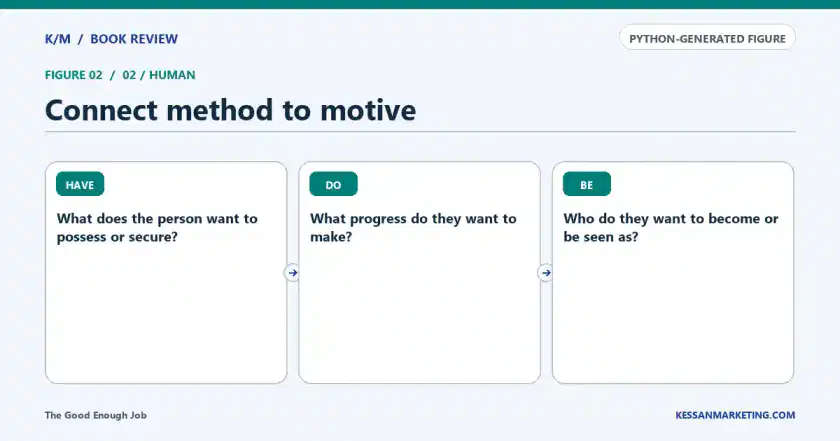
Most business choices are shaped by a mixture of functional, emotional, and social needs. People want progress, but they also want security, autonomy, belonging, recognition, and relief from effort or embarrassment.
The Good Enough Job becomes more powerful when its method is connected to those motives. A tactic aimed only at functional efficiency may fail if it increases social risk, uncertainty, or the fear of regret.
Describe WHO as a person in a specific situation and WHAT as the change that person seeks. This is more actionable than a broad demographic or a generic promise to “improve experience.”
Where the argument can fail
The main boundary is this: The goal is not indifference to work but diversified sources of meaning. Every framework highlights some variables and hides others, so a good review must state the conditions under which the recommendation could be wrong.
Examples in a book demonstrate possibility, not prevalence. Check the period, market structure, company capabilities, incentives, and selection process before assuming that the same result is reproducible.
Also watch for second-order effects. A method can improve conversion while damaging trust, raise revenue while lowering margin, or speed decisions while reducing dissent and learning.
A seven-day experiment
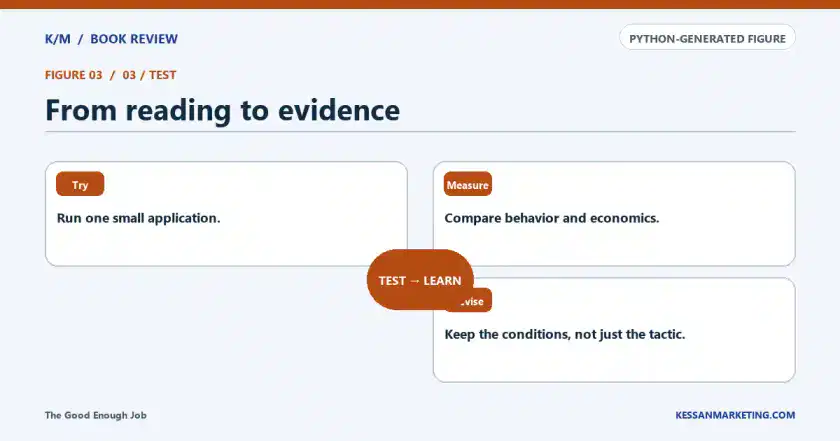
On day one, write the problem and current evidence. On day two, define the customer or organizational situation. On day three, select one idea from the book and translate it into an observable action.
Run the smallest credible test during days four and five. Record what happened, not only what participants said. On day six, compare the outcome with the strongest alternative explanation.
On day seven, decide whether to continue, revise, or stop. Preserve the reasoning and conditions, because the reusable asset is not the tactic itself—it is the quality of the decision process.
Final assessment
The Good Enough Job deserves attention when the reader needs a clearer way to connect an idea with action and evidence. Its usefulness increases when the team resists the temptation to turn the framework into a slogan.
The best takeaway is not a quote. It is a repeatable question that changes resource allocation, customer value, operating behavior, or financial performance.
Read the book with a live decision, a defined boundary, and a plan to measure consequences. That is how a book review becomes a practical management tool rather than a summary.
Where the argument may fail
The goal is not indifference to work but diversified sources of meaning. Examples show possibility; they do not guarantee the same result in a different market, organization, or period.
A seven-day application
1. Concentrating meaning, belonging, and self-worth in work makes both people and organizations fragile
Map a week of time and recognition across work, family, friends, learning, and community
2. Apply it to one live decision: Map a week of time and recognition across work, family, friends, learning, and community.
Define the evidence and review window before execution.
3. Measure hours, recovery, intent to leave, nonwork ties, vacation use, and psychological safety.
Record the conditions that support or contradict the book’s argument.
The Good Enough Job book review FAQ
What is The Good Enough Job about?
The Good Enough Job is best read as a decision system. The practical thesis is that Concentrating meaning, belonging, and self-worth in work makes both people and organizations fragile. This review turns that idea into an experiment, metrics, and explicit limits.
What are the key takeaways from The Good Enough Job?
Concentrating meaning, belonging, and self-worth in work makes both people and organizations fragile Apply it to one live decision: Map a week of time and recognition across work, family, friends, learning, and community. Measure hours, recovery, intent to leave, nonwork ties, vacation use, and psychological safety.
Is The Good Enough Job worth reading?
It is most useful when its method fits a live decision and you can test the result. Read it with the limits above rather than treating every example as a universal rule.
We separate the book’s argument from our editorial application. Last checked 2026-08-11.
Read our editorial methodology →